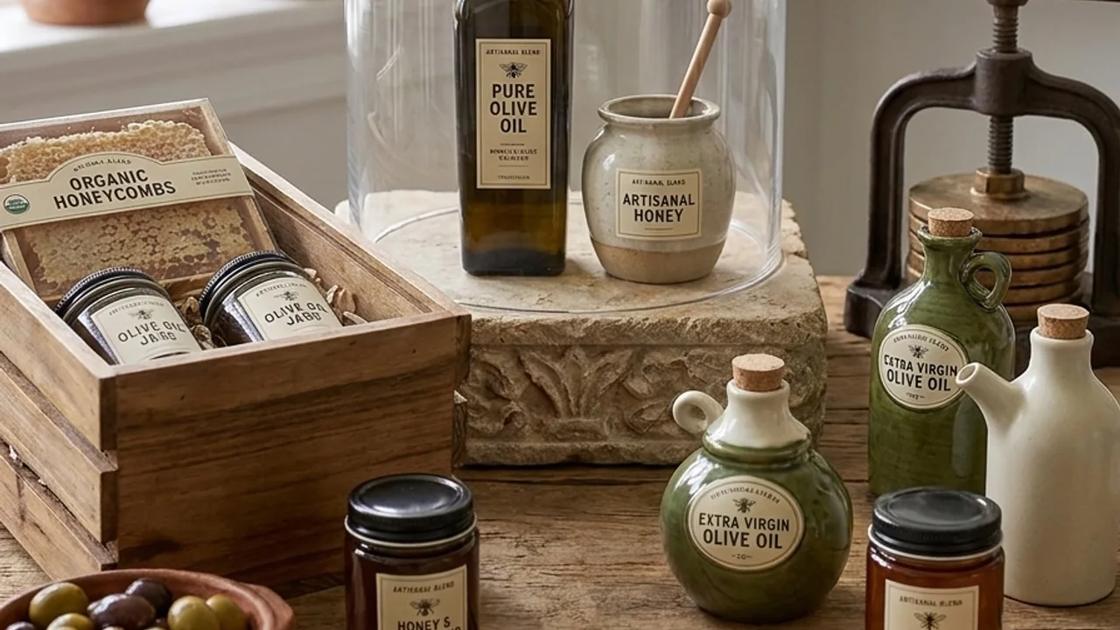
Two pantry staples with a very long history, and a very short routine
A short editorial note on the old-world pantry: the shelf that holds it, the table it feeds, and the small morning habits some readers describe keeping for months.
Most kitchens have one shelf that never really changes. A bottle, a jar, a small tin that gets refilled instead of replaced. In habit journals, some people write that this shelf is the first thing they notice in the morning, and that noticing it is what makes the rest of the routine happen at all.
Editorial notes suggest the same idea in plainer terms: a routine tends to hold when the objects it depends on are already in view, at the height of the hand, in the room where the day starts. Nothing about that is new. It is roughly how kitchens were arranged long before anyone wrote about habits.
Two ancient staples
Olive oil
Pressed the same way for a very long time
Fruit, pressure, time. That is the whole method, and the shape of the tool barely changed for most of its history. Stone presses turn up wherever old Mediterranean settlements are excavated, and the oil itself appears in trade records, household inventories and some of the earliest written material that survives.
Honey
Gathered long before anyone kept bees
Among the oldest scenes painted on rock are figures climbing toward wild hives with baskets and rope. Keeping bees on purpose came much later. By then honey was already listed beside grain and oil in ancient inventories, moving as a trade good and as tribute across cultures that had little else in common.
Inside the full brief
How an ordinary kitchen shelf can carry a very long history
Two of the plainest things in a modern pantry have been sitting on shelves, in one form or another, for as long as people have been writing things down.
What two of the oldest pantry staples have in common
Both are harvested rather than manufactured, both travelled as currency in the ancient world, and both outlasted nearly every kitchen that stored them.
Why starting small tends to stick longer than a full overhaul
Editorial notes suggest that one small repeatable action survives a crowded week far better than a rewritten schedule that assumes every day goes to plan.
The role of simple daily anchors in a crowded week
Readers describe one fixed point in the morning, usually at the table, that the rest of the day gets arranged around instead of competing with.
The full editorial
A short presentation on old pantries and slow mornings
It covers where these two staples came from, how they ended up on nearly every table in the ancient Mediterranean, and the small routines some readers say they borrowed from an older kitchen.
This policy explains what information is collected when a visitor uses this website, how that information is used, and what choices a visitor has. By using this website, a visitor agrees to the practices described here.
2. Information collected
Two broad categories of information are collected:
Information provided voluntarily, such as a name or email address submitted through a contact form or a subscription field.
Information collected automatically by browsing, such as IP address, browser type and version, device type, operating system, referring page, pages viewed, time spent on each page and general geographic region derived from network data.
3. How information is used
Information is used to operate and maintain the website, to understand how visitors navigate it, to measure the performance of published content and advertising, to respond to messages sent through the contact channel, to improve the layout and structure of pages, and to comply with applicable legal obligations.
4. Cookies and similar technologies
This website uses cookies, pixels, tags and similar technologies to remember preferences, to keep sessions consistent and to measure traffic and campaign performance. Some of these technologies are placed by analytics and advertising providers. Most browsers allow cookies to be blocked or deleted through their settings. Disabling cookies may affect how parts of the site function.
5. Sharing with third parties
Information is not sold. It may be shared with service providers who operate infrastructure on behalf of this website, including hosting, analytics, email delivery and advertising measurement, and only to the extent needed to perform those services. Information may also be disclosed when required by law, by valid legal process, or where disclosure is necessary to protect rights, safety or the integrity of the service. If the operation of the site is transferred to another party, information may be transferred as part of that transaction.
6. Third-party links
Pages on this site may link to websites that are operated independently. Those websites have their own privacy practices, and this policy does not apply to them. Visitors are encouraged to read the policy of any site they visit through a link published here.
7. Sensitive information
This website does not collect, request or infer sensitive personal information. It does not collect or infer religious belief, health status, medical history, or any special category of personal data, and it does not build audience segments based on such categories. References to culinary traditions published on this site are historical and cultural in nature and are not used to infer anything about a visitor.
8. Choices and rights
Depending on the applicable law, a visitor may request access to the information held about them, request correction of inaccurate information, request deletion, object to certain processing, or withdraw consent previously given. Requests can be submitted through the contact channel published in the footer of this site. Reasonable steps are taken to verify identity before a request is processed.
9. Data retention and security
Information is retained only for as long as it is needed for the purposes described in this policy or for as long as required by applicable law, after which it is deleted or anonymised. Reasonable administrative and technical measures are used to protect information against loss, misuse and unauthorised access. No method of transmission or storage is completely secure, and absolute security cannot be guaranteed.
10. Adults only
This website is intended for adults. It is not directed to children, and information is not knowingly collected from minors. If information belonging to a minor has been submitted, a request can be sent through the contact channel so that it can be removed.
11. Changes to this policy
This policy may be updated from time to time. The revised version takes effect when it is published on this page, and continued use of the website after publication constitutes acceptance of the revised policy.
Terms of Use
Last updated: 2026
1. Acceptance of these terms
By accessing or using this website, a visitor accepts these terms in full. Anyone who does not accept them should not use the website.
2. Permitted use
This website may be used for lawful personal and informational purposes. It may not be used to attempt unauthorised access to any system, to interfere with the operation or availability of the service, to collect data by automated means without permission, to reproduce or republish content for commercial purposes, to misrepresent an affiliation with the site, or to transmit unlawful, misleading or harmful material.
3. Intellectual property
Text, layout, graphics, code and other material published on this website are protected by applicable intellectual property law and remain the property of their respective owners. No licence is granted other than the right to view the content for personal, non-commercial use. Trade names and marks that appear on this site belong to their respective owners and are used for identification only.
4. Advertising, affiliate links and third-party sites
This website publishes sponsored content and may earn compensation from links published on its pages. Links may lead to websites operated by third parties. Those websites are independent, and the operator of this site does not control their content, their offers, their pricing, their delivery or their policies, and accepts no responsibility for them. Any transaction entered into on a third-party website is between the visitor and that third party.
5. Nature of the content
The content published here is editorial and educational. It discusses food history, culinary tradition and everyday household routines in a historical and cultural context. It is not medical, nutritional, legal or financial advice, it is not a substitute for professional evaluation, and it should not be relied upon as guidance for any health-related decision. No statement on this site should be read as a claim that any food, tradition or routine diagnoses, treats, cures or prevents any condition.
6. Professional consultation
Anyone considering a change to their diet, their routine or their use of any product should consult a qualified healthcare professional first, particularly if they are pregnant or nursing, have a diagnosed condition, or take medication. Nothing published on this site should be used to delay, replace or disregard professional advice.
7. Disclaimer of warranties
This website and its content are provided on an as-is and as-available basis, without warranties of any kind, whether express or implied, including implied warranties of merchantability, fitness for a particular purpose and non-infringement. No warranty is given that the site will be uninterrupted, error-free, secure, or that the information published is complete, accurate or current.
8. Limitation of liability
To the maximum extent permitted by applicable law, the operator of this website is not liable for any indirect, incidental, special, consequential or punitive damages, or for any loss of profits, data, goodwill or opportunity, arising from the use of or inability to use this website, from reliance on any content published here, or from any transaction with a third party reached through this site.
9. Indemnity
A visitor agrees to hold the operator of this website harmless from claims, demands, losses and expenses arising from their use of the site or from any breach of these terms.
10. Changes and availability
Content, features and these terms may be modified, suspended or discontinued at any time and without notice. The revised terms take effect when published on this page, and continued use of the website constitutes acceptance of them.
11. Governing law and severability
These terms are governed by the laws applicable in the place where the operator of this website is established, without regard to conflict-of-law rules. If any provision is found unenforceable, the remaining provisions continue in full force.
12. Contact
Questions about these terms can be sent through the contact channel published in the footer of this website.